
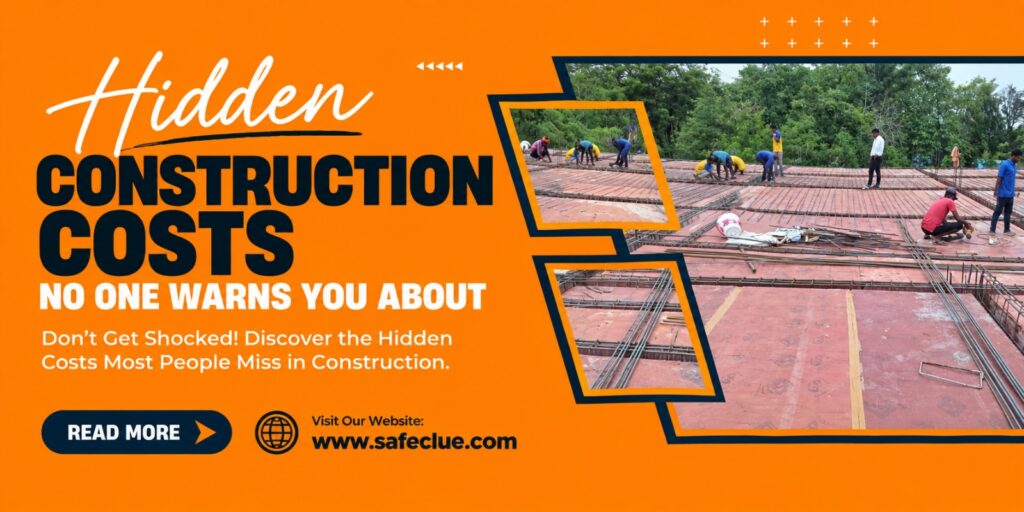
You get a quote. It looks reasonable. You sign off, construction begins, and somewhere around the third month, the bills start creeping past what you’d planned for. It’s rarely one dramatic overrun — it’s a steady accumulation of costs that were technically always going to happen, but never made it into the original number.
At Safeclue, we see this pattern often enough that we built our Smart Estimator specifically to surface these costs before they surprise you. Here are the 15 that catch homeowners and business owners off guard most often — and how to plan around them from day one.
15 Hidden Construction Costs No One Warns You About
1. Soil Testing and Foundation Adjustments
A basic quote usually assumes standard soil conditions. But soil across Odisha varies a lot — sandy, rocky, or waterlogged plots (common near Subarnapur and low-lying stretches around Balangir) can require deeper foundations, extra piling, or soil stabilization. This alone can add a meaningful percentage to your foundation cost, and it’s only discoverable once a proper soil test is done.
2. Government Approvals and Permit Fees
Building plan sanction, environmental clearance, water and sewer connection charges, and municipal development fees are all separate from construction cost — and they vary by local body. Many first-time builders assume “the builder will handle it,” without realizing these are pass-through costs, not included in the per-square-foot rate.
3. Site Preparation and Land Levelling
Clearing vegetation, leveling uneven ground, removing old structures, or building retaining walls on a sloped plot — none of this is “construction” in the traditional sense, but it has to happen before construction starts, and it’s rarely priced into a base estimate.
4. Boundary Wall and Main Gate
It sounds obvious, but boundary walls, compound gates, and site security are frequently left out of the headline estimate because they’re treated as a separate “phase.” If you’re budgeting off a per-square-foot number for the house alone, this cost arrives as a surprise later.
5. Temporary Water and Electricity Connections
Construction sites need power and water from day one — for mixing concrete, running equipment, and site lighting. Temporary connection charges, generator rental, or water tanker costs (especially relevant for sites without an existing borewell) add up over a multi-month build.
6. Architect and Structural Engineer Fees
If your quote is purely a construction rate, design and structural engineering fees are often billed separately. Skipping proper structural design to save this cost is one of the riskier shortcuts in home building — it’s also where Safeclue’s 20-year structural warranty means these costs are already accounted for, not bolted on later.
7. GST and Statutory Taxes
Materials and labor are subject to GST, and depending on your contract structure, this may or may not be baked into the number you were first quoted. Always confirm whether a quote is inclusive or exclusive of tax before comparing it to another.
8. Material Price Escalation
Steel and cement prices fluctuate, sometimes significantly, over a 6–12 month build. A quote locked in at the start of a project doesn’t protect you from these swings unless it explicitly says so. This is exactly why transparent, milestone-based billing — where you see real costs as they happen — protects you more than a single fixed number promised upfront.
9. Upgraded Fittings and Fixtures
Base estimates typically include “standard” sanitaryware, taps, switches, and door hardware. The moment you upgrade to branded fittings, a modular kitchen, or premium bathroom fixtures, costs shift — often by more than people expect, because fittings are priced per unit, not per square foot.
10. Interior Finishing Beyond Civil Work
False ceilings, wardrobes, modular kitchens, decorative lighting, and painting beyond a basic coat are frequently quoted as a separate scope from “civil construction.” If your budget only covers structure and basic finish, furnishing-level interiors are an entirely additional line item.
11. Labour Cess and Statutory Levies
Construction projects above certain values attract a labour welfare cess, mandated by law. It’s a small percentage, but it’s mandatory, and unfamiliar builders sometimes discover it only when the final bill arrives.
12. Mid-Project Design Changes
Moving a wall, resizing a window, adding a balcony after the foundation is laid — every change order after construction has begun costs more than the same decision made on paper. Design changes mid-build are one of the single biggest sources of budget overrun, precisely because they’re the easiest to underestimate.
13. Weather and Monsoon Delays
Odisha’s monsoon season isn’t optional to plan around. Delays mean idle labour costs, material protection and storage, and a stretched timeline — which itself adds cost even without a single design change. Builders who don’t account for seasonal delays in their timeline are quietly passing that risk on to you.
14. Landscaping and External Development
Driveways, boundary paving, external lighting, and garden or lawn work are almost always excluded from the core construction quote — they’re “site development,” a separate scope that’s easy to forget until the house itself is nearly done.
15. Post-Handover Costs
Occupancy certificate fees, utility connection charges in your name, society or association charges (for apartment or commercial builds), and ongoing maintenance are costs that begin exactly when you thought the spending was over. This is also where a maintenance support window — like Safeclue’s 2-year post-handover support — matters, since early-stage issues after moving in are common and costly to handle alone.
How to Actually Budget for These

The honest fix isn’t to memorize all fifteen — it’s to work with a construction partner who prices transparently from the start, rather than presenting a low headline number and letting the rest surface later.
That’s the specific problem Safeclue’s Smart Estimator is built to solve. Instead of one flat per-square-foot figure, you can adjust plot size and finish quality — Basic, Standard, or Premium — and see how your total shifts in real time, before you’ve committed to anything. Combined with milestone-based project tracking and a live dashboard through construction, you see costs as they’re incurred, not after.
Planning a build in Balangir, Subarnapur, Rourkela, Jharsuguda, or Jamshedpur? Try the Smart Estimator to see a realistic starting number, or book a free consultation with Safeclue to walk through your specific plot and finish level before you budget a single rupee.