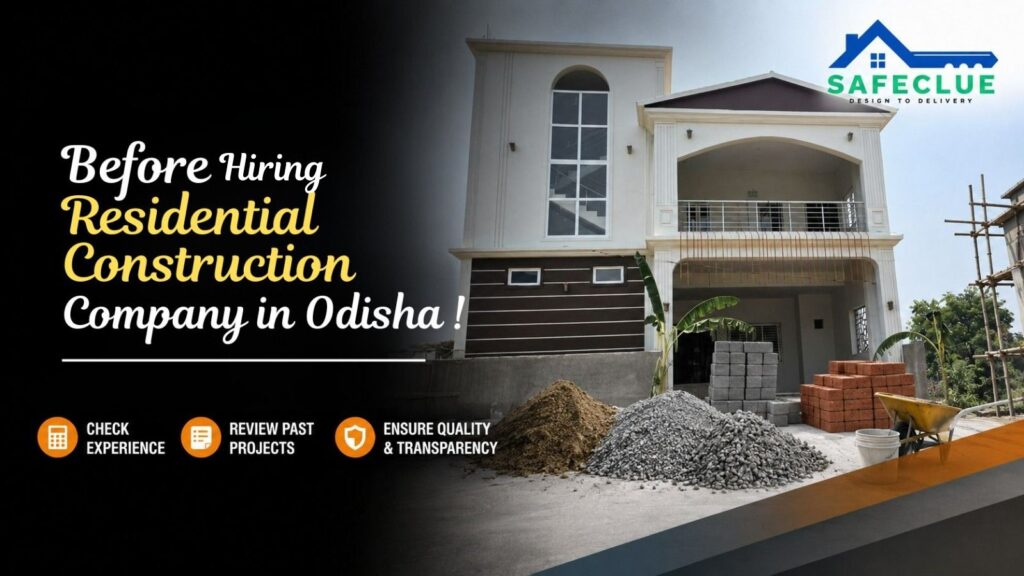
Choosing the right residential construction company is an important decision because the quality of construction, project cost, timeline, and long-term durability of your home depend heavily on the contractor you hire. Before signing an agreement, homeowners should carefully evaluate the company, its construction process, pricing, materials, documentation, and after-sales support.
Based on Safeclue’s residential construction approach, which emphasizes transparency, safety, regulatory compliance, milestone tracking, cost estimation, and end-to-end project management, here are 15 important points to check.
15 Points You Need to Check Before Hiring a Residential Construction Company in Odisha
1. Check the Company’s Experience
Start by checking how long the construction company has been operating and what types of residential projects it has completed. Experience in handling different house designs, site conditions, and construction challenges can help reduce project risks.
2. Review Previous Residential Projects
Ask the company to show completed and ongoing residential projects. Reviewing actual projects can help you understand the quality of construction, finishing, design execution, and workmanship.
3. Verify Construction Services
Check whether the company provides complete residential construction services or only handles selected stages. A company offering planning, design, construction, project supervision, and final handover can make project management easier.
4. Ask for a Detailed Cost Estimate
Do not rely only on a basic per-square-foot price. Ask for a detailed estimate covering materials, labour, structural work, electrical work, plumbing, flooring, doors, windows, kitchen, bathrooms, and finishing.
A transparent estimator can also help homeowners compare different construction-quality packages before making a decision. Safeclue, for example, provides an online construction cost estimator with different finish levels.
5. Check for Hidden Costs
Ask clearly what is included and excluded from the quoted price. Additional costs related to design changes, site conditions, materials, approvals, transportation, or finishing should be discussed before construction begins.
6. Verify the Quality of Construction Materials
Ask which brands and grades of cement, steel, tiles, sanitaryware, electrical products, doors, windows, and other materials will be used. The material specifications should ideally be documented in the agreement.
7. Understand the Construction Timeline
Ask for an estimated completion date and a phase-wise construction schedule. A proper milestone-based schedule makes it easier to monitor whether foundation, structure, masonry, electrical, plumbing, finishing, and handover are progressing as planned.
8. Check How Project Progress Is Monitored
Find out how you will receive updates during construction. Digital dashboards, milestone tracking, photographs, site reports, and regular communication can provide greater visibility into project progress. Safeclue highlights real-time project monitoring and milestone tracking as part of its construction approach.
9. Verify Building Approvals and Compliance
Ask who will manage required drawings, permissions, approvals, and applicable building regulations. Regulatory compliance should be clearly addressed before construction starts.
10. Ask About Safety Standards
Construction-site safety should not be overlooked. Check whether the company follows proper safety procedures, conducts quality checks, and maintains a safe working environment throughout the project.
11. Understand the Contract Terms
Before signing, carefully review the agreement covering project scope, specifications, payment schedule, construction timeline, material brands, responsibilities, changes, delays, and handover conditions.
12. Check the Payment Schedule
Avoid making decisions based only on the lowest quotation. Understand when payments are due and whether payments are linked to construction milestones. A clear payment structure can help maintain financial control throughout the project.
13. Ask About Warranty and Maintenance Support
Find out what happens after the house is handed over. Ask about structural warranty, defect rectification, maintenance support, and the process for raising post-construction complaints. Safeclue states that it provides a 20-year structural warranty and 2-year maintenance support.
14. Read Client Reviews and Testimonials
Look for genuine customer feedback about communication, workmanship, transparency, project timelines, quality, and post-handover support. Reviews can provide useful insights that may not be visible from a company’s marketing material.
15. Check Communication and Transparency
Finally, choose a construction company that communicates clearly and keeps you informed. From cost estimation to construction progress and final handover, transparency can make the entire house-building experience more predictable and less stressful.
Final Thoughts
Hiring a residential construction company should not be based solely on the lowest quotation. Homeowners should compare experience, project portfolio, construction quality, material specifications, pricing transparency, timelines, safety, approvals, project monitoring, warranty, and after-sales support before making a final decision.
A professional construction partner should be able to take the project from planning and budgeting to construction and final handover while keeping the homeowner informed throughout the process. Safeclue positions its residential construction service around this end-to-end, transparent approach.